MIT FutureTech / CSAIL · Summer 2026–Present
VLA Manipulation Research
I design custom simulation tasks and build the data, training, and evaluation pipelines to study how vision-language-action models learn manipulation.
01 My work
From expert motion
to learned behavior.
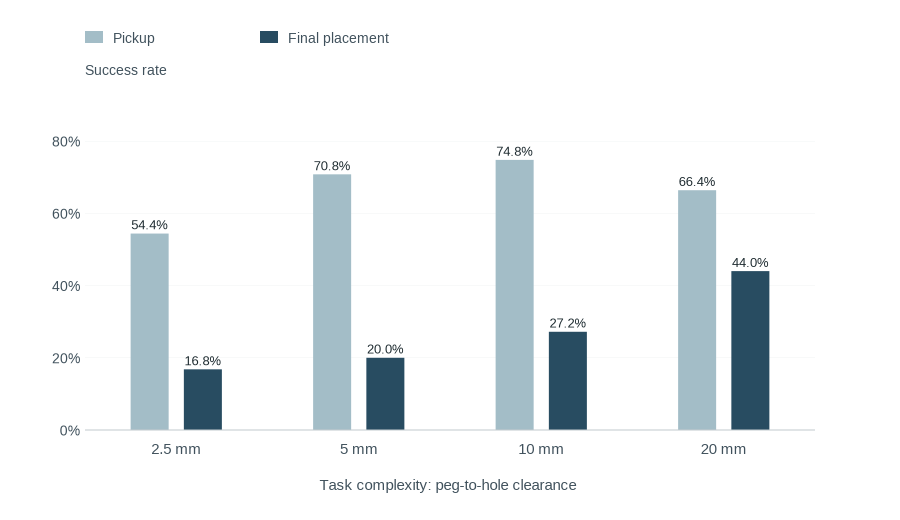
I designed this custom peg-in-hole environment in MuJoCo for MolmoSpaces evaluation with a Franka arm. Peg-to-hole tolerance defines task complexity: tighter clearance demands more precise placement.
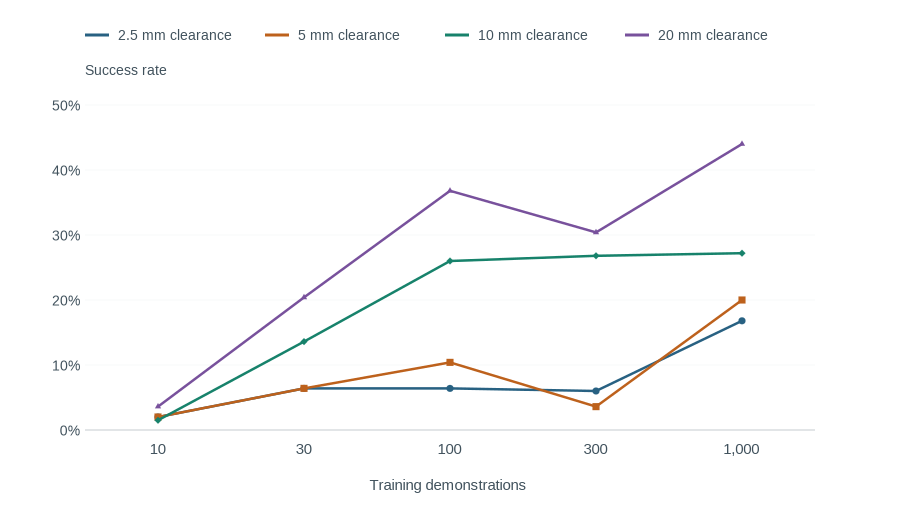
I connected expert data generation, LeRobot datasets, MolmoAct2 LoRA fine-tuning, and rollout scoring to compare 2.5, 5, 10, and 20 mm diametrical clearances across five training budgets.
02 Results · October 2026
Learning across
task complexity.
final placement success at 20 mm clearance with 1,000 training demonstrations.110 successful placements / 250 evaluation episodes
How training data changes placement success
Task complexity: tighter clearance, greater precision
03 TextileBench · In development
Benchmarking robots
on textile work.
I designed TextileBench: 20 tasks for bimanual textile and garment manipulation with two YAM arms. The tasks test perception, instruction following, and coordination through activities such as fabric sorting, seam guidance, folding, and garment handling.
Each task includes a randomized setup and measurable scoring criteria. Our team advanced to the final stage of RoboCurve’s open-source benchmarking program; task simulations are in development.
A benchmark for bimanual textile and garment manipulation
20 task designs · 23 pages Read the proposal ↗